Super Journal: an online turf research resource
Super Journal is provided by PACE Turf as a free public service to the turfgrass management community. Our mission is to provide an electronic venue for:
- Superintendents to publish results of their turf research projects and to share them with fellow turf managers.
- Turf researchers to rapidly publish and disseminate their experimental results.
- Superintendents who want assistance in designing, carrying out, interpreting and/or summarizing turf research experiments.
Please see our submission guidelines if you wish to have your report published in Super Journal, and our research guide for information on designing and implementing your own turf research project.
2019 GIS Kikuuyugrass
Wendy and Larry both participated in the Kikuyugrass A-Z session at the Golf Industry Show (GIS) this year. In addition, Pat Gross from the USGA, Fernando Varela from Guadalajara Country Club, Pat Gradoville from Palos Verdes Golf Club, and Dr. Marta Pudzianowska from UC Riverside provided some great information. The presentations are available at the links below:
- Kikuyugrass from A to Z - Climate and diseases by Larry Stowell, Ph.D
- Kikuyugrass from A to Z - Nutrition by Larry Stowell, Ph.D
- Kikuyugrass from A to Z - Insects by Wendy Gelernter
- Kikuyugrass from A to Z by Fernando Varela
- Kikuyugrass from A to Z by Pat Gradoville, CGCS
- Kikuyugrass from A to Z by Marta Pudzianowska, Ph.D
- Kikuyugrass from A to Z by Pat Gross
- Kikuyugrass Management Survey 2010
Shoebox irrigation audit
What do shoe boxes and irrigation audits have in common? Everything, if you are going to use the shoe box as an inexpensive catch can.
In previous updates, we have directed you to use custom catch cans specifically designed for irrigation audits. But we have seen that most of you find the custom catch cans to be expensive and sometimes difficult to use. Therefore, we are recommending that you give plastic shoe boxes a try instead — they are easier to get a hold of, and much cheaper to buy. You can purchase the new catch cans for less than $2.00 US each when you buy them in lots of 20. These handy boxes can be purchased at most Container stores.
You will have to make a few easy calculations to obtain total precipitation and precipitation rate but we have provided an Audit calculator spreadsheet to help you out. You will also need a 500 ml graduated cylinder to measure the volume of the water collected in the shoe box. The process that we outline here will allow you to use any rectangular–shaped container to compute precipitation and, if you know the irrigation run time, precipitation rate.
Once you have purchased your shoe boxes, the first step is to record the dimensions of the opening (length and width) of your container in centimeters (enter this information in cells B1 and B2 of Audit calculator spreadsheet). We are going metric at this point because the calculations are easier to understand (we will convert back to inches of precipitation and inches per hour (in/hr) in the end). Once you have these measurements (30.2 x 17.2 cm = 522.46 cm² for the Container Store box), you are ready to conduct the audit.
Let's start with a two can audit as we have described in a previous post.
- Set up at least two catch cans (shoe boxes) per test area - one catch can in good performing turf and another in an adjacent area of poor performing turf. Set them up in the late afternoon/early evening before the normally scheduled irrigation cycle begins.
- Print out a copy of the Audit calculator spreadsheet to take with you out onto the golf course, so that you can enter all of the appropriate values by hand. Once you return to the office, you can re-enter these figures onto the electronic version of the spreadsheet, and the spreadsheet can do much of the calculation work. You can also then save your work for future reference by clicking "Save as" in the File menu.
- Record the irrigation run time for the area you are auditing (in cell B3 of the Audit calculator spreadsheet).
- Once the irrigation cycle has been completed, carefully pour the contents of each catch can into the graduated cylinder and record the volume (milliliters [ml] = cubic centimeters [cm³]) of water collected in column B (under the "ml" heading). Once you type this number into the spreadsheet, it will automatically calculate the number of inches collected (column F) and the precipitation rate [number of inches per hour] (column G) that is being delivered to the turf. If you want to perform these calculations by hand, see the NOTE below.
- On the spreadsheet, also record information about the location of each catch can in column A (e.g. "fairway 1 left, near 150 yard marker"), and in column H, record turfgrass quality (we suggest a "G" for good performing turf and a "P" for poor performing turf).
- If you find that your poor performing turf is being irrigated with less water than you desire, the system will have to be adjusted to compensate. To make this adjustment, divide the desired precipitation volume (the amount, in ml, that you collected in your good performing turf) by the observed precipitation volume (ml) in your poor performing turf. The number that you obtain is the factor by which you will need to increase water delivery by. For example, if the desired precipitation is 220 ml per cycle, and you observe 183 ml, then you will need to increase the volume of water delivered by a factor of 1.2.
With water conservation on everyone's mind, irrigation efficiency will become more important. For information on how to conduct a comprehensive irrigation audit and to calculate the uniformity of your irrigation system, refer to PACE Insights Vol. 6 No. 6 for more information.
NOTE: To calculate precipitation volumes by hand, divide the volume of water collected by the area, in cm², of the opening (522.46 cm² for the Container Store shoe box). For example, if 205 cm³ water was collected overnight, the precipitation would be 0.42 cm (205 cm³ ÷ 522.46 cm² = 0.42 cm). To convert cm to inches, divide by 2.54 (0.42 cm ÷ 2.54 in/cm = 0.17 in). To calculate precipitation rate in inches per hour, divide by the run time in minutes and then multiply by 60 min/hour. For example, 0.17 in ÷ 10 min = 0.017 in/min and 0.017 in/min X 60 min/hr = 1.02 in/hr.
References:
- Irrigation related photographs: PACE Turf Gallery
Minimum Levels for Sustainable Nutrition Soil Guidelines (MLSN)
Just released: For a comprehensive discussion of MLSN, refer to "The secret MLSN Operations Manual" written by Dr. Micah Woods.
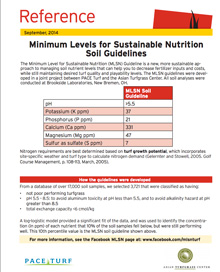
Increased economic and environmental pressures have caused many turfgrass managers to re–assess the way you manage turf. With fertilizers as one of the bigger inputs, we felt that it was time to review and revise our current soil guidelines to reflect these changes. The result is the "Minimum Level for Sustainable Nutrition" (MLSN) soil guidelines, a new, more sustainable approach to managing soil nutrient levels that can help you to decrease inputs and costs, while still maintaining desired turf quality and playability levels. Used in conjunction with Climate Appraisals and Growth Potential, annual fertilizer needs can be estimated.
Working together with Dr. Micah Woods of the Asian Turfgrass Center, the guidelines were produced through review of key soil nutrient data from thousands of turf soil samples. Based on our evaluations, we determined that in many cases, guidelines could be safely lowered without a dramatic impact on turf quality or playability.
Since their introduction in 2012, the MLSN guidelines have been adopted by turf managers around the world, who have been surprised to find just how "low they can go" as they more precisely target the nutrient levels that the turf needs.
Scientific basis for the MLSN Guidelines:
- Woods MS, Stowell LJ, Gelernter WD, 2016. Minimum soil nutrient guidelines for turfgrass developed from Mehlich 3 soil test results. PeerJ Preprints 4:e2144v1 https://doi.org/10.7287/peerj.preprints.2144v1
- Stowell, L. and Woods, M. 2014. Minimum levels for sustainable nutrition. Bouyoucos Conference
- Stowell, L., Woods, M. and Gelernter, W. 2014. Only what the turf needs: updating the Minimum Levels for Sustainable Nutrition Guidelines. Crop Science Society of America meetings, November 5, 2014.
Turf management articles about the MLSN Guidelines:
- Woods, M. 2018. New MLSN Cheatsheet. Asian Turfgrass Center
- Woods, M., Stowell, L. and W. Gelernter, 2014. Just what the grass requires: using minimum levels for sustainable nutrition. Golf Course Management, January, 2014.
- Haines. J. 2014. Sustainable fertilizer use.
- Thayer, A., 2013. Cut costs with better turf management. Western Turf, Winter, 2013.
- Gelernter, W., Stowell, L and Woods, M. 2013. Documenting your progress toward sustainability. Golf Course Management, December, 2013.
Websites with more information about the MLSN Guidelines: