Soil
2019 GIS Kikuuyugrass
Wendy and Larry both participated in the Kikuyugrass A-Z session at the Golf Industry Show (GIS) this year. In addition, Pat Gross from the USGA, Fernando Varela from Guadalajara Country Club, Pat Gradoville from Palos Verdes Golf Club, and Dr. Marta Pudzianowska from UC Riverside provided some great information. The presentations are available at the links below:
- Kikuyugrass from A to Z - Climate and diseases by Larry Stowell, Ph.D
- Kikuyugrass from A to Z - Nutrition by Larry Stowell, Ph.D
- Kikuyugrass from A to Z - Insects by Wendy Gelernter
- Kikuyugrass from A to Z by Fernando Varela
- Kikuyugrass from A to Z by Pat Gradoville, CGCS
- Kikuyugrass from A to Z by Marta Pudzianowska, Ph.D
- Kikuyugrass from A to Z by Pat Gross
- Kikuyugrass Management Survey 2010
Minimum Levels for Sustainable Nutrition Soil Guidelines (MLSN)
Just released: For a comprehensive discussion of MLSN, refer to "The secret MLSN Operations Manual" written by Dr. Micah Woods.
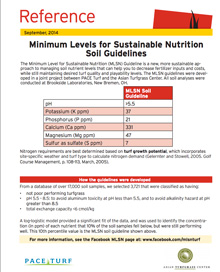
Increased economic and environmental pressures have caused many turfgrass managers to re–assess the way you manage turf. With fertilizers as one of the bigger inputs, we felt that it was time to review and revise our current soil guidelines to reflect these changes. The result is the "Minimum Level for Sustainable Nutrition" (MLSN) soil guidelines, a new, more sustainable approach to managing soil nutrient levels that can help you to decrease inputs and costs, while still maintaining desired turf quality and playability levels. Used in conjunction with Climate Appraisals and Growth Potential, annual fertilizer needs can be estimated.
Working together with Dr. Micah Woods of the Asian Turfgrass Center, the guidelines were produced through review of key soil nutrient data from thousands of turf soil samples. Based on our evaluations, we determined that in many cases, guidelines could be safely lowered without a dramatic impact on turf quality or playability.
Since their introduction in 2012, the MLSN guidelines have been adopted by turf managers around the world, who have been surprised to find just how "low they can go" as they more precisely target the nutrient levels that the turf needs.
Scientific basis for the MLSN Guidelines:
- Woods MS, Stowell LJ, Gelernter WD, 2016. Minimum soil nutrient guidelines for turfgrass developed from Mehlich 3 soil test results. PeerJ Preprints 4:e2144v1 https://doi.org/10.7287/peerj.preprints.2144v1
- Stowell, L. and Woods, M. 2014. Minimum levels for sustainable nutrition. Bouyoucos Conference
- Stowell, L., Woods, M. and Gelernter, W. 2014. Only what the turf needs: updating the Minimum Levels for Sustainable Nutrition Guidelines. Crop Science Society of America meetings, November 5, 2014.
Turf management articles about the MLSN Guidelines:
- Woods, M. 2018. New MLSN Cheatsheet. Asian Turfgrass Center
- Woods, M., Stowell, L. and W. Gelernter, 2014. Just what the grass requires: using minimum levels for sustainable nutrition. Golf Course Management, January, 2014.
- Haines. J. 2014. Sustainable fertilizer use.
- Thayer, A., 2013. Cut costs with better turf management. Western Turf, Winter, 2013.
- Gelernter, W., Stowell, L and Woods, M. 2013. Documenting your progress toward sustainability. Golf Course Management, December, 2013.
Websites with more information about the MLSN Guidelines:
MLSN and GP at the 2017 GIS
Jason Haines (@PenderSuper on Twitter) and Larry Stowell (@paceturf on Twitter) taught a half-day course on Minimum Levels for Sustainable Nutrition (MLSN) guidelines and Growth Potential (GP) to more than 100 golf course superintendents from around the world. The slide presentation and handout materials used for the course have been provided at the links below: